
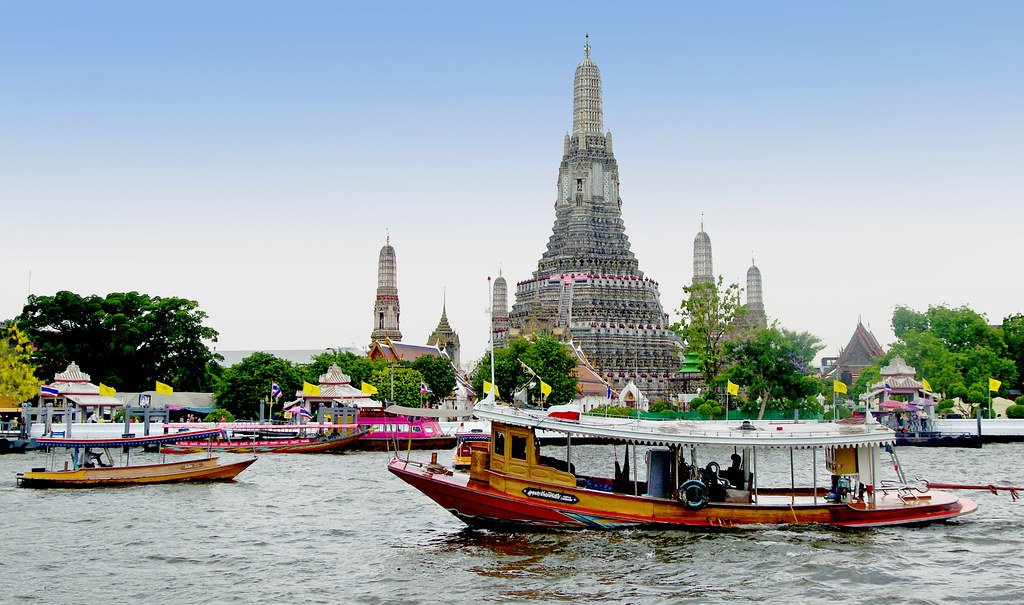
Most visitors give Bangkok two nights on the way to an island and come away thinking it is chaotic and exhausting. Four days is the sweet spot. It is long enough to see the temples properly, eat your way through several neighbourhoods, take a day trip out of the city and still have an afternoon spare. This itinerary is built around beating the heat rather than ignoring it.
How to plan around the heat
The single biggest mistake first-time visitors make is scheduling temple visits for the middle of the day. Bangkok is hot and humid year-round, and between roughly 11am and 3pm you will be uncomfortable and slow. Build your days the way residents do: outdoors early, indoors or on the water in the afternoon, outdoors again after five.
Temples also enforce a dress code. Shoulders and knees covered, for everyone. Bring a light long-sleeved layer rather than relying on the sarongs available to rent at the entrance.
Getting around
Bangkok traffic is genuinely severe, and a journey that looks short on a map can take an hour in a car. Use the BTS Skytrain and MRT metro wherever they go, and the Chao Phraya express boats along the river, which are cheap and often faster than the roads. Ride-hailing apps are widely used and remove any haggling. Metered taxis are fine when the meter is actually running.
Tuk-tuks are fun for a short hop but are not the cheap option, and drivers who approach you unprompted near major temples are often working a commission scheme. If someone tells you the Grand Palace is closed today, it almost certainly is not.
Day 1: The old city and the river
Start at the Grand Palace at opening time. It is the busiest sight in the city and the queues build fast. Inside the same complex is Wat Phra Kaew, home of the Emerald Buddha, which is the most revered image in the country.
Walk ten minutes south to Wat Pho for the enormous reclining Buddha and the traditional massage school on site, which is the most authentic place in Bangkok to try a Thai massage. Cross the river by ferry in the late afternoon to Wat Arun, whose porcelain-encrusted spire is at its best in low sun.
Day 2: Markets and modern Bangkok
If your trip includes a weekend, spend the morning at Chatuchak Weekend Market, one of the largest markets anywhere, with thousands of stalls arranged in numbered sections. Go early, agree a meeting point with your group and accept that you will get lost.
In the afternoon, escape into the air conditioning around Siam, where the major shopping centres are connected by elevated walkways. The food halls here are a genuinely good introduction to Thai food if you are nervous about street stalls on day one. In the evening, head to a rooftop bar for the skyline. Most enforce a smart-casual dress code.
Day 3: A day trip out of the city
- Ayutthaya — the ruined former capital, reachable by train or minivan, with temple complexes spread across an island site. The most rewarding option historically.
- Damnoen Saduak or Amphawa — the floating markets. Amphawa is more relaxed and more local; Damnoen Saduak is more photographed and more commercial.
- Maeklong Railway Market — a market built directly on live railway tracks, with awnings pulled back each time a train passes. Often combined with a floating market visit.
All three involve an early start. Ayutthaya works well independently by train; the market trips are usually easier as an organised half-day.
Day 4: Neighbourhoods and food
Use the final day for the parts of Bangkok that are not on a sightseeing list. Chinatown, along Yaowarat Road, is the best street food in the city and comes alive after dark. Banglamphu and the lanes around Phra Athit Road show a quieter, residential side of the old quarter. Lumphini Park in the early morning is full of people exercising, and occasionally monitor lizards.
For street food, the reliable rule is to eat where there is a queue of locals and high turnover. Busy stalls sell fresh food quickly, which is exactly what you want.
Where to stay
- Sukhumvit — best transport links, widest range of hotels and restaurants. The easiest choice for first-timers.
- Riverside — the most scenic, with express boat access, though further from the metro.
- Silom — business district by day, lively by night, well connected by both BTS and MRT.
- Old city and Khao San — closest to the temples and cheapest, but poorly served by rail.
Frequently asked questions
How many days do you need in Bangkok?
Three to four. Two days covers the main temples in a rush; four lets you add a day trip and explore a neighbourhood properly without fighting the afternoon heat.
When is the best time to visit Bangkok?
November to February is the cool, dry season and the most comfortable window. March to May is the hottest, and the wet season runs roughly June to October, usually bringing heavy but short afternoon downpours rather than all-day rain.
Is street food in Bangkok safe?
Generally yes, if you choose busy stalls with fast turnover and food cooked to order in front of you. Stick to bottled water and be a little more cautious with pre-cut fruit left sitting out.
Do I need to cover up at the temples?
Yes. Shoulders and knees must be covered at the Grand Palace and major temples, and the rule is enforced at the entrance. Shoes come off before you enter a temple building.
Is Bangkok a good first stop in Southeast Asia?
It is one of the best. Transport is straightforward, English is widely spoken in tourist areas, accommodation spans every budget and onward flights across the region are frequent and inexpensive.
Pingback: Vietnam Itinerary: 10 Days from Hanoi to Ho Chi Minh City - Lisa World Travel