
Some links in this post are booking links. If you book through them we may earn a small commission at no extra cost to you. We only link to services we would use ourselves, and it never changes what we recommend.
Machu Picchu is no longer a place you can simply turn up to. Over the past few years it has moved to a system of timed entry, fixed one-way circuits, daily visitor caps and separately ticketed add-on climbs. Most of the frustration visitors experience comes from arriving with out-of-date information.
Here is how the pieces fit together, and the order to book them in.
Book in this order
- 1. Your Machu Picchu entry ticket. This is the scarce item and everything else depends on it.
- 2. Your train. Times need to match your entry slot.
- 3. Accommodation in Aguas Calientes or Ollantaytambo.
- 4. Everything else.
Doing this in the wrong order is the single most common planning mistake, because people book flights and hotels and then discover their preferred entry date is full.
Tickets and circuits
Entry is by timed slot, and your ticket specifies a circuit: a defined one-way route through the site. You cannot wander freely or double back, which surprises people who have seen older guidebooks.
Different circuits reach different parts of the site, and crucially not all of them include the classic postcard viewpoint. If that photograph matters to you, check specifically which circuit provides it before purchasing, because it is entirely possible to visit Machu Picchu and never stand where the famous image was taken.
Tickets are sold through the official government platform, with a limited daily allocation. Third-party resellers exist and charge a premium. The number of circuits, their names and their contents have all been revised more than once, so treat the official site as the only current source.
The add-on climbs
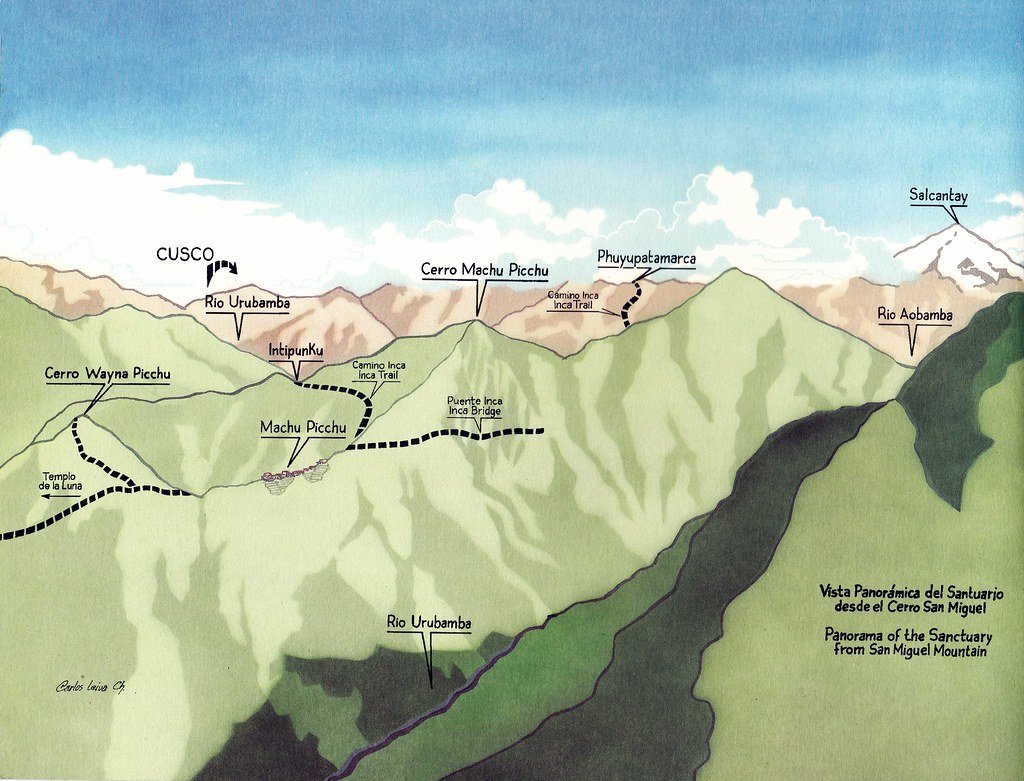
Huayna Picchu is the steep peak behind the ruins in every photograph. The climb is short, very exposed in places and not suitable for anyone uneasy with heights or narrow steps. It sells out furthest in advance.
Machu Picchu Mountain is higher, longer and less vertiginous, with a broader view over the whole valley. It is the better choice for most people and easier to get.
Both are bought as a combined ticket with a specific circuit, not added afterwards, so decide before you buy.
Staying the night before
An early entry slot is far better than a late one, and that means sleeping close by:
Getting there: the train
There is no road to Aguas Calientes. Two operators run the rail line, with services from Ollantaytambo and, on some schedules, from near Cusco. Ollantaytambo is the usual and shorter departure point.
Service classes range from basic to panoramic-window luxury, and prices differ accordingly. Trains sell out in high season and schedules are occasionally disrupted by weather or maintenance on the line.
From Aguas Calientes, shuttle buses run up the switchbacks to the entrance, taking around half an hour. You can walk up instead, a steep climb of roughly an hour and a half on stone steps. Bus queues before dawn are long, so join them earlier than feels reasonable.
Getting there: trekking
The classic Inca Trail takes four days, requires a permit released months in advance, must be booked through a licensed operator, and closes for maintenance for one month each year. Permits for peak months disappear almost immediately on release.
The Salkantay trek is the main alternative: longer, higher, more dramatic and not permit-limited in the same way. The Lares and Inca Jungle routes are gentler and more cultural.
Only the Inca Trail arrives through the Sun Gate on foot. Every other route joins the standard entry system.
On the day
- Bring your passport. It is checked against your ticket, and the entrance has a stamp.
- Guides are required on some circuits and useful on all of them. You can hire one at the entrance.
- Large bags are not permitted inside; there is storage at the gate.
- There are no toilets inside the site. Use the ones at the entrance before you go in.
- Bring water, sun protection and a rain layer. Cloud forest weather changes within minutes.
- Re-entry is not allowed, so once you exit, that is the visit.
Frequently asked questions
How far ahead should I book?
For dry season travel, several months. For the Inca Trail, longer still. Outside peak season you have more flexibility, but the add-on climbs remain scarce year-round.
Can I visit as a day trip from Cusco?
It is possible and it makes for a very long day with an early start and a late return. Staying in Aguas Calientes or Ollantaytambo the night before is far better.
Is it worth climbing Huayna Picchu?
If you are comfortable with heights and steep exposed steps, the view down over the site is exceptional. If you are not, Machu Picchu Mountain gives you a comparable reward with far less anxiety.
What if it is cloudy?
Morning cloud is common and often burns off within an hour or two. Do not panic at the gate; the site frequently reveals itself gradually, which is memorable in its own right.
Pingback: Peru Itinerary: 10 Days from Cusco to Machu Picchu - Lisa World Travel
Pingback: Best Time to Visit Peru: A Month-by-Month Guide - Lisa World Travel