

I’ll be honest: when I booked my November trip to Paris, I did not picture myself checking a list of closed Metro stations over my morning coffee. But that’s exactly how my Saturday started — and you know what? It turned out to be one of the most memorable days I’ve had in this city. Not despite the strikes. Kind of because of them.
If you’re wondering whether Paris is still worth visiting right now, or you’ve got a trip booked and you’re nervously refreshing the news, this is the post I wish I’d read before I came. Here’s what my Saturday in Paris during the strikes was actually like.

What Was Actually Happening in Paris Today
Let me give you the facts first, because the headlines make it sound scarier than it felt on the ground.
Today, Saturday, November 21, is the sixth straight Saturday of protests in France over the rising cost of living — and a special one, because it’s also the eighth anniversary of the Yellow Vests movement. The big march in Paris was approved by the police prefecture, and it follows one single route: from Place de la République, straight down Boulevard Voltaire, to Place de la Nation, setting off at 2pm. Unions, student groups, housing campaigners and the Yellow Vests are all marching together on that same route.
The police deployed around 70,000 officers across France, and intelligence services expected somewhere between 15,000 and 30,000 people in Paris. The US, UK, Canada and Australia all issued travel advisories for the weekend — but none of them told people not to come. France is still at Level 2: exercise increased caution. In other words: come, but keep your eyes open.
One thing that surprised me: the march route the Yellow Vests originally wanted — from Bastille all the way to Concorde, past the Champs-Élysées — was rejected. Gatherings near the Champs-Élysées and Place de la Concorde were banned outright. So the action was all concentrated in eastern Paris, and the west of the city felt almost normal.
My Saturday Morning: A Quiet City Before 2pm
I started my day early at Place de la République, the square where the march would begin. At 9am it was almost eerily calm — a few joggers, a man walking his dog, the Marianne statue standing over an empty square. It was hard to believe that in five hours this would be the starting point for tens of thousands of people.
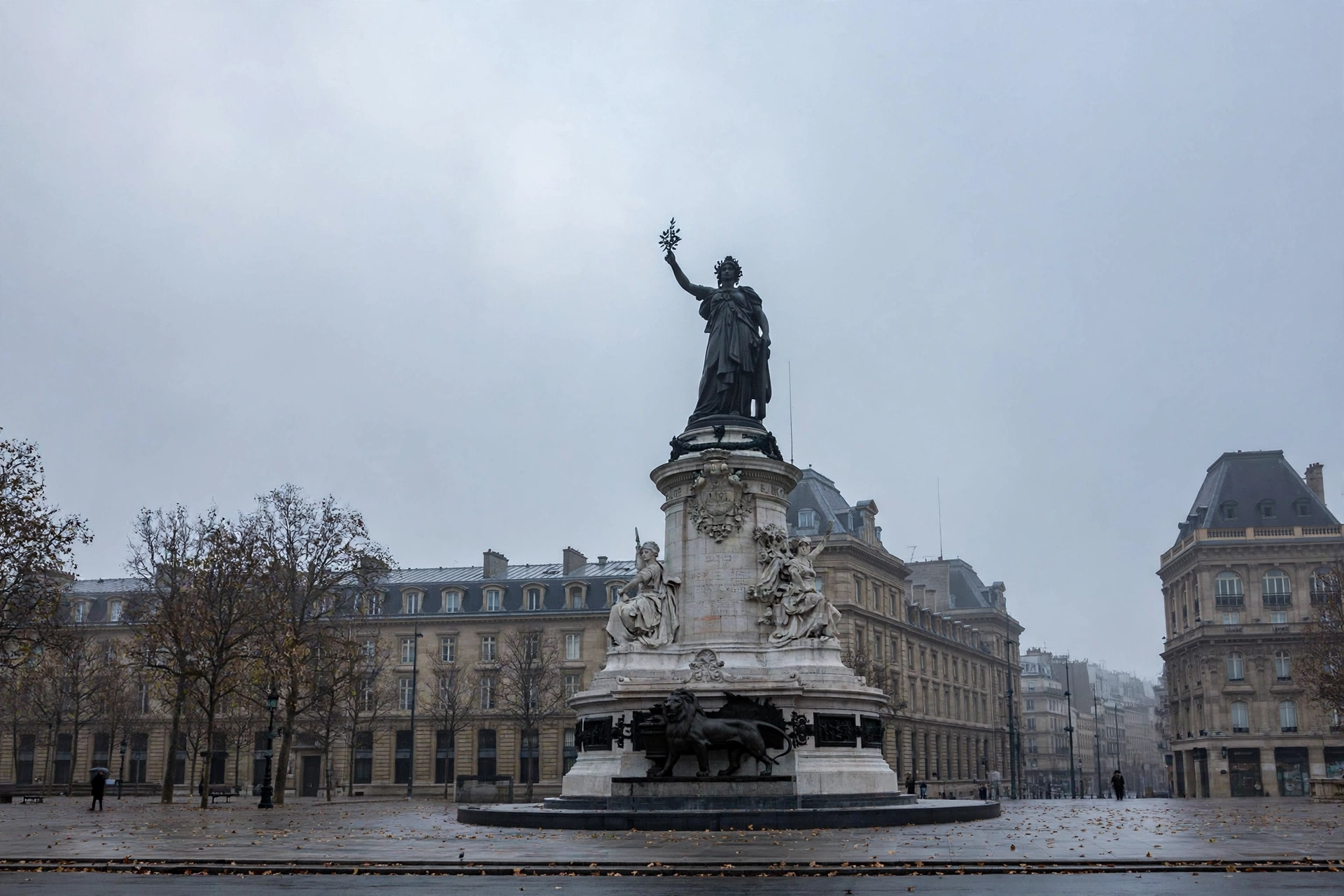
From there I wandered through Le Marais, which was doing what Le Marais does best: pretending nothing unusual was happening. Bakeries were open, the smell of fresh bread was everywhere, and shopkeepers were putting out their displays like any other Saturday. The only hint of the day ahead was the occasional police van parked at a crossroads and the closed shutters on a couple of banks near République.
By late morning I did what any sensible person does in Paris when the city gets complicated: I found a café terrace, ordered a coffee and a croissant, and settled in to watch the world go by. Honestly, this might have been my favourite hour of the whole trip.

The Metro Closures — The Part That Actually Affected Me
Here’s the thing nobody tells you: the protests themselves barely touched my day. The Metro closures did. Sixteen stations were closed across the city on Saturday, and if you didn’t know the list, you could easily end up walking a lot further than planned.
Closed all day from the start of service (mostly in western Paris, around the Champs-Élysées and Concorde): Tuileries, Concorde, Champs-Élysées–Clemenceau, Franklin D. Roosevelt, George V, Charles de Gaulle–Étoile, Argentine and Miromesnil. Line 1 was the worst hit — seven stations in a row closed — though it still served Palais-Royal, Hôtel de Ville, Bastille and Nation.
Closed from 11am along the march route: Oberkampf, Richard-Lenoir, Saint-Ambroise, Voltaire, Charonne and Rue des Boulets. From noon: Les Halles and Châtelet. Lines 6 and 11 were also partly suspended from noon.
The good news? République, Nation and Bastille — the three stations you’d actually want — stayed open. Trains kept running through the closed stations, they just didn’t stop. And nobody announced a reopening time in advance: stations reopen only when the prefecture says so, so the Bonjour RATP app became my best friend for the day.
One more thing to know if you’re flying out: the RER B to Charles de Gaulle stops running at 10:45pm on weeknights until December 11, and the Aulnay-sous-Bois to Mitry-Claye section is closed this weekend — though the airport branch itself isn’t affected. And on Sunday, Metro line 6 is closed all day for maintenance. Plan around it.
7 Things I’d Tell Any Friend Visiting Paris During a Strike
1. Check the RATP app before you leave the hotel. Station closures are announced the day before and updated live. The Bonjour RATP app tells you in real time what’s open. Don’t rely on yesterday’s news.
2. Stay west, or stay flexible. The march route was République to Nation, all in eastern Paris. The west — the Eiffel Tower, the Champs-Élysées, Saint-Germain — carried on almost normally. If your hotel is in the east, just plan your sightseeing for the morning and the west in the afternoon.
3. Walk more than you planned. Paris is a walking city anyway, and on a strike day the streets between the closed stations are often the quietest and prettiest. My best photos of the day came from the walk I hadn’t planned.
4. Avoid the march corridor in the afternoon. Don’t try to cross Boulevard Voltaire between 1pm and 7pm. It’s not dangerous for a bystander, exactly — but you’ll be stuck behind barriers, the buses are diverted, and it’s just not a fun way to spend an afternoon. Watch it from a café a few streets away if you’re curious.
5. Allow double the time for the airport. Between the RER B evening cut-off and the weekend engineering works, the journey to Charles de Gaulle takes longer than usual. Leave early, and check the RER B status the night before.
6. Keep your phone charged and your hotel address handy. Mobile networks get congested around big crowds, and if you need to reroute on foot, you’ll want your maps working. A portable charger is worth its weight in gold on days like this.
7. Don’t cancel — just adjust. Paris doesn’t close for a strike. The museums open, the cafés open, the croissants are still warm. The city just asks you to be a little more patient and a little more flexible than usual. That’s a pretty good deal.
Would I Still Go to Paris Right Now?
Yes. A hundred times yes. Would I go back to République at 2pm on a Saturday to stand in the middle of a march? No — and you shouldn’t either. But would I book the flight, pack my warmest coat, and spend a November weekend eating my way across Paris while the city has one of its dramatic days? Absolutely.
There’s something about Paris on a day like this that you don’t get on a perfect sunny Tuesday in June. The city feels alive. People are talking to each other in cafés about what’s happening. The streets feel like they belong to the people walking them. And when the march passed and the evening came, the lights came on, the restaurants filled up, and Paris did what Paris always does — it carried on being Paris.
Actually, if you love this city as much as I do, you might enjoy my other Paris-season adventures too: my magical Christmas weekend in New York has the same festive energy Paris gets in December, and my 3-day New York itinerary is full of the kind of walking-and-café days I lived on this trip. And if you want to know what not to do on a city trip, my 7 NYC mistakes apply just as well in Paris — especially the one about not checking transport before you leave the hotel!
Oh, and one last thing: if you’re in Paris this weekend, the Champs-Élysées Christmas lights switch on Sunday. A march on Saturday, lights on Sunday. Only Paris.
Have you ever been caught in a strike or a protest while travelling? Did it ruin your trip — or secretly make it better? Tell me in the comments, I’d love to hear your story.