
Some links in this post are booking links. If you book through them we may earn a small commission at no extra cost to you. We only link to services we would use ourselves, and it never changes what we recommend.
Belgrade’s neighbourhoods have far more distinct personalities than the map suggests, and choosing well makes a real difference to how the city feels. Here are the five worth considering.
Stari Grad, the old town
Best for: first-time visitors, short stays, walking everywhere.
Stari Grad covers Knez Mihailova, Republic Square, Skadarlija and Kalemegdan fortress, which is to say almost everything you came to see. Staying here means you can leave your hotel and be at the fortress in ten minutes.
Accommodation ranges from grand old hotels to modern apartments in converted buildings. Prices are the highest in the city and still modest by Western European standards.
The trade-off: Skadarlija and the surrounding streets are noisy well into the night, particularly at weekends. Ask for a courtyard-facing room.
Dorćol
Best for: repeat visitors, longer stays, a local feel.
Dorćol slopes from the old town down towards the Danube, and it is where a lot of Belgraders would actually choose to live. Specialty coffee, small wine bars, independent restaurants and residential calm, all within walking distance of the centre.
Mostly apartments rather than hotels, which suits stays of several nights.
The trade-off: it is a walk uphill back from the river, and the lower streets are quieter than some visitors expect in the evening.
Compare by neighbourhood
Prices between these areas vary less than in most capitals, so pick on character rather than budget:
Savamala
Best for: nightlife, design hotels, riverside.
The riverfront district below the centre, home to the creative scene, the summer club barges and a run of bars in converted warehouses. It has been transformed by the Belgrade Waterfront development, which has added a lot of glass and a lot of opinions.
The trade-off: construction noise in places, and a night-time crowd that goes on very late. Excellent if that is why you came; less so otherwise.
Zemun
Best for: families, quiet, a small-town atmosphere.
Zemun was a separate Austro-Hungarian town until the twentieth century and still looks and feels like one: low houses, a hill topped by the Gardoš Tower, and a long riverside promenade of fish restaurants.
It is roughly twenty to thirty minutes from the centre by bus, which is the main consideration.
The trade-off: you commit to the commute. Worth it for a longer stay or with children.
Vračar
Best for: value, residential comfort, a short walk to the centre.
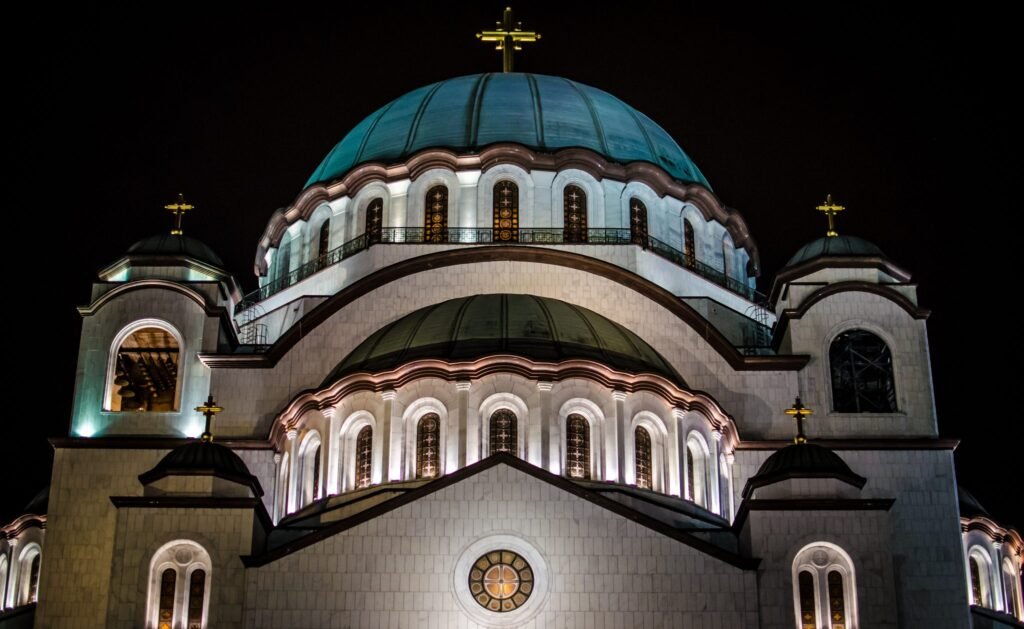
Vračar surrounds the Temple of Saint Sava and is one of the most desirable residential areas in the city: leafy streets, good bakeries, ordinary neighbourhood restaurants and reliably lower prices than Stari Grad, with the centre fifteen minutes away on foot.
The trade-off: very few sights of its own beyond the temple, so you will be walking or riding in every day.
Quick recommendations
- Two nights, first visit: Stari Grad.
- Four nights or more: Dorćol.
- Travelling with children: Zemun or Vračar.
- Here for the nightlife: Savamala.
- On a tight budget: Vračar, which offers the best combination of price and walkability.
Booking tips
- Apartments outnumber hotels and are generally good value; check reviews for lift access, as many older buildings have none.
- Air conditioning matters in July and August, when the city gets genuinely hot.
- Heating matters in winter; older buildings run on district heating with limited individual control.
- Check the walk to a bus or tram stop if you are outside Stari Grad.
- Book ahead for the EXIT festival period in July, which fills accommodation in both Novi Sad and Belgrade.
Frequently asked questions
Is Belgrade expensive?
It is one of the better-value capitals in Europe, particularly for food and drink. Accommodation has risen in recent years but remains well below Western European levels.
Do I need a car?
No, and parking in the centre is difficult. Hire a car only if you are leaving the city for the monasteries or the south.
Which area is best for a solo traveller?
Dorćol or Stari Grad. Both are walkable, well lit and full of places where sitting alone with a coffee is entirely normal.
How far is the airport?
Nikola Tesla airport is around twenty to thirty minutes from the centre depending on traffic, with a bus service and taxis operating on a zone-based fare system.
What Belgrade accommodation is actually like
The stock is a mix of grand old state hotels, a growing number of small design hotels, and a very large supply of privately let apartments in buildings of every era from Austro-Hungarian to socialist-modernist to new-build.
The older buildings have the character and often the high ceilings and original floors. They also frequently have narrow stairwells, no lift, and communal entrances that look considerably less appealing than the apartment behind the door. This is normal and not a warning sign.
Heating in older blocks runs on district systems with a fixed seasonal schedule, so early autumn and late spring can be chillier indoors than out. Air conditioning in summer is essential and not universal; confirm it explicitly.
Breakfast is often not included with apartments, which is no loss at all: the bakeries are excellent and a burek and yoghurt costs almost nothing.
Getting between neighbourhoods
Stari Grad, Dorćol, Savamala and Vračar are all within walking distance of one another, though Belgrade is hillier than it looks and the climb up from the rivers is real.
Zemun is the exception, at roughly twenty to thirty minutes by bus from the centre. It is a pleasant ride along the river but it is a commitment each time you make it.
Buses and trams are frequent and cheap. Ticketing arrangements in Belgrade have changed more than once in recent years, so check the current system when you arrive rather than relying on older guidance.
Pingback: Belgrade Itinerary: How to Spend 3 Days in Belgrade - Lisa World Travel
Pingback: Serbia on a Budget: What a Trip Really Costs - Lisa World Travel