
Some links in this post are booking links. If you book through them we may earn a small commission at no extra cost to you. We only link to services we would use ourselves, and it never changes what we recommend.
Tanzania holds the most concentrated wildlife spectacle on the planet, and also the most confusing set of booking decisions in African travel. Northern circuit or southern? Migration season or green season? Lodge, tented camp or mobile camp? The answers matter, because a safari is expensive enough that getting the timing wrong is an expensive mistake rather than a minor one.
This guide covers the main parks, what the Great Migration actually does across the year, and how to decide when to go.
The northern circuit
Most first safaris happen here, on a loop out of Arusha. The parks are close enough together to combine by road in a week.
Serengeti National Park
Roughly the size of Northern Ireland, and the stage for the Great Migration. Big cat density is exceptional, particularly in the central Seronera area, which has year-round water and therefore year-round resident game. The Serengeti is not one destination but several, and which section you stay in should follow where the herds are.
Ngorongoro Crater
A collapsed volcanic caldera roughly twenty kilometres across, with steep walls that hold a resident population of around twenty-five thousand large animals on the floor. It is the most reliable place in Tanzania to see black rhino, which completes the Big Five for most itineraries.
Be realistic about the experience: the crater floor is enclosed and busy with vehicles, and it feels less wild than the Serengeti. It is also unmissable. One full day is enough.
Tarangire National Park
Baobab trees and very large elephant herds, especially in the dry season when animals concentrate along the Tarangire River. Frequently treated as a warm-up stop and frequently the surprise highlight.
Lake Manyara
Small, forested and known for tree-climbing lions and flamingos on the soda lake. Half a day. Easily skipped if time is tight.
The southern and western circuits
Nyerere National Park, formerly Selous, and Ruaha are enormous, far less visited and offer boat safaris and walking safaris that the northern parks largely do not. Katavi and Mahale sit further west; Mahale is where you trek for wild chimpanzees on the shore of Lake Tanganyika.
These are generally second-safari destinations. They involve more flying, cost more per day and reward travellers who want solitude over guaranteed big-name sightings.
The Great Migration through the year
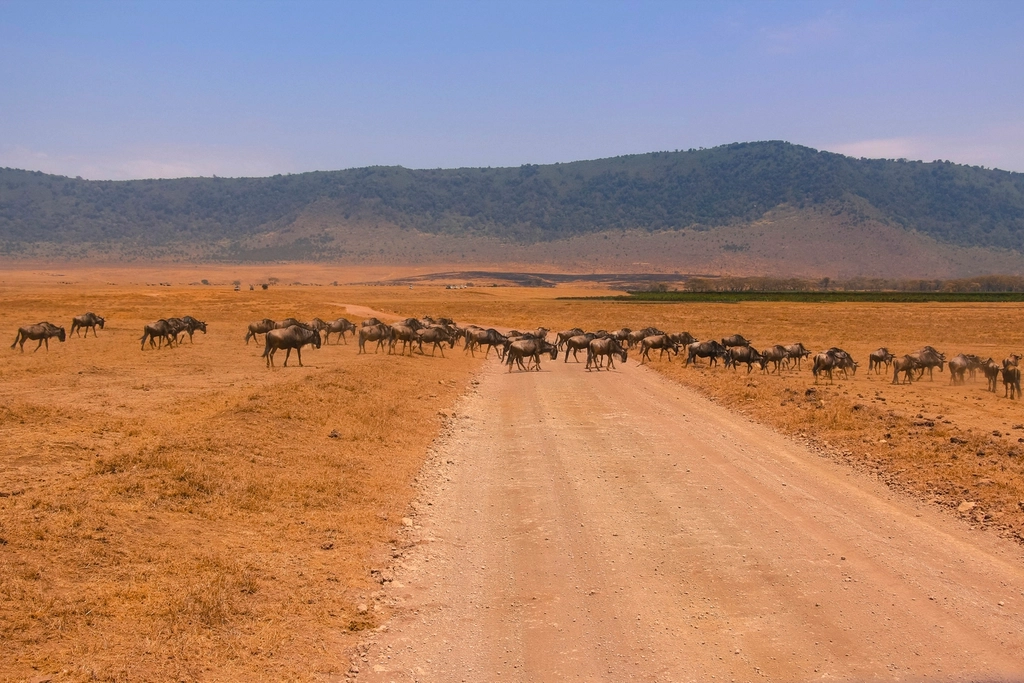
The migration is a continuous clockwise loop of roughly two million wildebeest, zebra and gazelle between the Serengeti and Kenya’s Masai Mara. It is not an event on a date; it is a moving population. Broadly:
- December to March. Herds are on the southern Serengeti short-grass plains. Calving peaks around late January and February, with enormous numbers of births in a short window and correspondingly intense predator activity. For many people this is the best time of all, and it is less crowded than the river-crossing season.
- April and May. The long rains. Herds move north-west. Many camps close; those open are cheap. Roads get difficult.
- June and July. Herds in the western corridor and moving north, with Grumeti River crossings possible.
- August to October. The famous Mara River crossings in the northern Serengeti. This is peak season, peak price and peak vehicle numbers. Crossings cannot be scheduled and some visitors wait days without seeing one.
- November. Short rains, herds moving back south. A quiet, good-value shoulder month.
The important caveat: the herds follow rainfall, and rainfall varies year to year. Any month-by-month map is a pattern, not a timetable.
Start planning your Tanzania safari
Camps in the northern Serengeti book out a year ahead for crossing season. Arusha and Zanzibar are the usual start and finish points:
Dry season or green season
The dry season, June to October, gives thinner vegetation, animals concentrated at water sources and almost no rain. It is the easiest time to see a lot quickly, and it is the busiest and most expensive.
The green season, roughly November to March, gives dramatic skies, newborn animals, migratory birds and far fewer vehicles, at meaningfully lower prices. Grass is longer so some sightings are harder, and April and May in particular can be genuinely wet.
If it is your first safari and you want volume of sightings, go dry season. If you have been before, or want calving and quiet, February is superb.
How long, and how to travel
Six to eight days on the northern circuit is the standard. Anything under four means most of your time is spent driving between parks. Road transfers are cheaper and let you see the country; light aircraft transfers cost more, save hours and are close to essential if you are going to the northern Serengeti or the southern parks.
Accommodation runs from permanent lodges to luxury tented camps to mobile camps that relocate with the herds. Mobile camps are the best value for migration chasing because they put you where the animals are rather than where a building was constructed.
Practical notes
Park fees are a large and non-negotiable share of the cost, charged per person per day. When comparing quotes, check carefully whether fees, transfers and drinks are included, because that is where apparently similar prices diverge.
Mornings and evenings on the Serengeti and especially on the Ngorongoro rim are cold. Pack a warm layer, which is the item most first-timers leave at home. Neutral colours, a hat and binoculars per person are the rest of the list.
Confirm visa requirements, yellow fever certificate rules for your routing and malaria precautions with official sources and a travel clinic well in advance.
Frequently asked questions
When is the best time for the Great Migration?
For river crossings, August to October in the northern Serengeti. For calving and predator action, late January and February in the south. The second is cheaper, quieter and more predictable.
Tanzania or Kenya for safari?
They share the same ecosystem. Tanzania’s parks are larger and feel wilder; Kenya is generally cheaper and easier to reach, with shorter drives. Many people eventually do both.
Is Ngorongoro worth the cost?
For a first trip, yes, largely for the black rhino and the density of animals in an enclosed space. On a repeat visit, some travellers spend that day and budget in the Serengeti instead.
Can I do a budget safari?
Yes. Group camping safaris out of Arusha are substantially cheaper than lodge itineraries, using shared vehicles and public campsites. Park fees still apply, so there is a hard floor below which no legitimate operator can go.
Should I add Zanzibar?
It is the classic pairing and the flight is short. A week of safari followed by four or five nights on the coast is the most common two-week Tanzania trip, and the dry seasons overlap well.
Pingback: Zanzibar Itinerary: How to Spend 7 Days in Zanzibar - Lisa World Travel
Pingback: Kenya Safari Cost: What a Trip Really Costs - Lisa World Travel
Pingback: Best Time to Visit Morocco: A Month-by-Month Guide - Lisa World Travel