
Some links in this post are booking links. If you book through them we may earn a small commission at no extra cost to you. We only link to services we would use ourselves, and it never changes what we recommend.
Uluru is not a stop on the way to somewhere else. It sits in the middle of the continent, a long way from everything, and the trip works best when you treat it as a destination in its own right.
Three nights is the right length. Here is how to plan them.
Getting there and where to stay
Fly directly into Ayers Rock Airport, which serves the resort town of Yulara, the only accommodation base inside the region. Flights connect from the major eastern cities and from Alice Springs.
Alternatively, fly to Alice Springs and drive the several hundred kilometres south-west, which lets you take in Kings Canyon on the way. It is a long, straight, memorable drive.
Yulara has everything from a campground to a luxury lodge, all run by the same operator. There is no other option within the park, so book early; it sells out.
Book ahead for the Red Centre
Accommodation here is limited and single-operator, so it fills months out in peak season:
Uluru itself
The Base Walk is the single best thing to do here. It circles the rock over roughly ten kilometres of flat ground, and the scale, the colour and the texture only make sense up close. Start at first light in the warmer months.
Shorter options include the Mala Walk, usually accompanied by a free ranger-guided talk, and the walk in to Kantju Gorge.
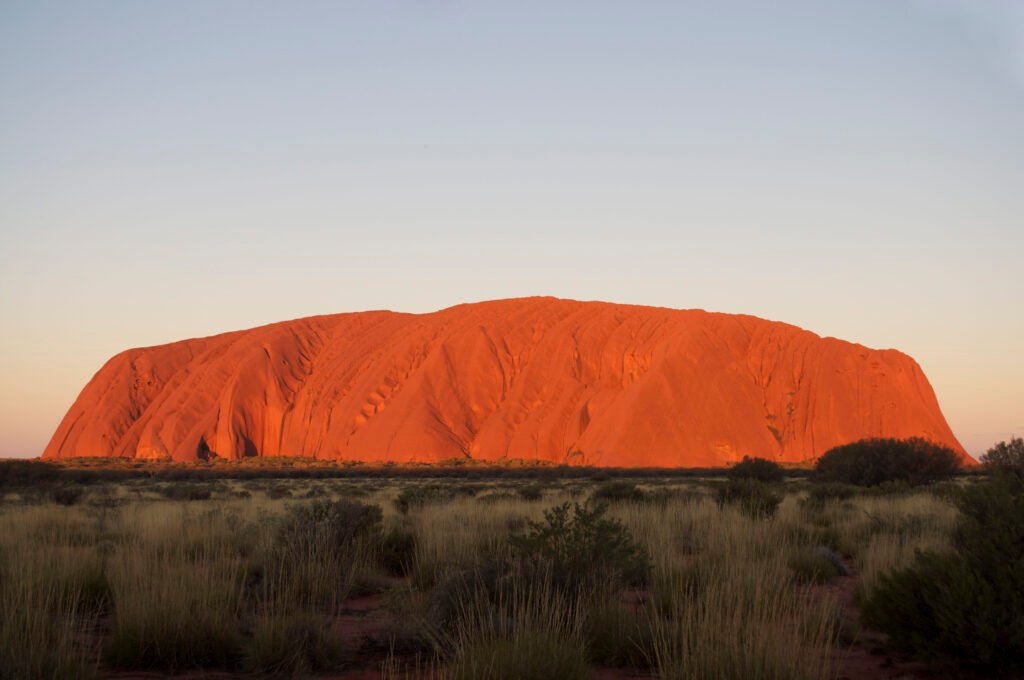
Sunrise and sunset have designated viewing areas. Both are worth doing; the rock changes colour far more dramatically than photographs suggest.
Climbing Uluru is permanently closed. The site is sacred to the Anangu, its traditional owners, and the closure reflects their long-standing wishes. Certain areas also may not be photographed; signs mark them clearly.
Kata Tjuta and Kings Canyon
Kata Tjuta, the domes about fifty kilometres west, is the one people skip and then regret skipping. The Valley of the Winds walk threads between the domes and is more dramatic than anything at Uluru itself. It is harder going, and sections close when the forecast is hot.
Kings Canyon, several hours’ drive north-east in Watarrka National Park, has the Rim Walk: a steep start followed by a loop along the canyon edge past sheer red walls and the sheltered Garden of Eden waterhole. Allow a full morning and start early.
Adding Kings Canyon means one or two extra nights and a hire car. It is worth it.
Desert practicalities
- Carry far more water than feels necessary, and drink it steadily rather than when thirsty.
- Walks close in the heat. Rangers close longer tracks from mid-morning when high temperatures are forecast.
- Flies are serious in the warmer months. A head net costs almost nothing and transforms the day.
- Fuel and supplies are limited. Fill up before long drives and carry spares.
- Nights get genuinely cold in winter, close to freezing. Pack layers.
- There is a park entry fee, valid for several consecutive days.
When to go
The cooler months, roughly May to September, are by far the best: warm days, cold nights, clear skies and manageable walking conditions.
The summer months are extremely hot, with daytime temperatures that make long walks dangerous and often prohibited. If you must come then, walk at dawn and rest through the middle of the day.
The desert sky at night is exceptional in any season.
Frequently asked questions
How many days do I need?
Three nights for Uluru and Kata Tjuta. Five if you add Kings Canyon properly.
Do I need a car?
Not strictly. Shuttles and tours run from Yulara to all the main sites. A car gives you sunrise on your own terms and is worth it if you are confident driving long desert distances.
Is it suitable for children?
Yes, with the shorter walks and careful heat management. The full Base Walk is a lot for small legs.
Can I see it as a day trip?
Technically, from Alice Springs. Please do not. It is a very long day for a very short visit.
Understanding the place you are visiting
Uluru is not scenery. It is a living cultural landscape that the Anangu have cared for over an extraordinarily long period, and almost everything you see there carries meaning that is not obvious to a visitor.
The Cultural Centre inside the park is the single best hour you can spend before doing anything else. It explains Tjukurpa, the body of law, knowledge and story that underpins Anangu life, and it reframes the walks that follow entirely.
Ranger-guided walks are free and often led by or developed with Anangu guides. Take one if the timing works.
Buy art from the community-owned art centres rather than from souvenir shops. The difference in who benefits is substantial, and the work is better.
Respect the photography restrictions at sensitive sites. They are marked, few in number, and the reasons are serious.
Other things to do
Beyond the walks, the Red Centre has a set of experiences that are worth building a day around.
- Stargazing. The sky here is as dark as it gets, and guided astronomy sessions run from the resort.
- Camel rides at sunrise or sunset, a nod to the Afghan cameleers who opened up the interior.
- Scenic flights by helicopter or light aircraft, which are the only way to grasp how isolated the rock is.
- Light installations in the dunes near the resort, which run seasonally and are genuinely striking.
- Bush tucker and dot-painting workshops, offered free at the resort’s town square.
- Sunrise at Kata Tjuta, which is quieter than the Uluru viewing areas and arguably better.