
Some links in this post are booking links. If you book through them we may earn a small commission at no extra cost to you. We only link to services we would use ourselves, and it never changes what we recommend.
The Great Barrier Reef is not a single place. It runs for more than two thousand kilometres along the Queensland coast, and where you access it from makes an enormous difference to what you actually see.
Here is how to choose a base, a boat and a way of getting in the water.
Choosing a gateway
Cairns is the main hub, with the widest choice of operators, day trips and liveaboards, plus an international airport. It is also the busiest, and the closest reef sites see a lot of traffic.
Port Douglas, an hour north, is smaller and more relaxed, and gives access to the Agincourt Ribbon Reefs on the outer edge of the continental shelf, which are generally in better condition than the inner reefs.
The Whitsundays, further south around Airlie Beach, combine reef access with the island scenery and Whitehaven Beach. Sailing trips here are a distinct and excellent way to do it.
Townsville and Lady Elliot Island at the southern end are quieter alternatives. Lady Elliot in particular has a strong reputation for manta rays and turtles.
Day trip, liveaboard or island stay
Day trips are the standard option: a fast catamaran out to a pontoon or to two or three reef sites, with snorkelling gear, lunch and often an introductory dive included. Simple, and enough for most people.
Liveaboards of two to four nights reach the outer reefs and the more remote sites, offer night dives, and are the serious diver’s choice. They also cost considerably more.
Island stays on places like Heron, Lady Elliot, Lizard or the Whitsunday resorts put you on the reef itself, with snorkelling straight off the beach in some cases.
Smaller boats going to fewer sites generally give a better experience than the large pontoon operations, though they are less comfortable in swell.
Diving and snorkelling
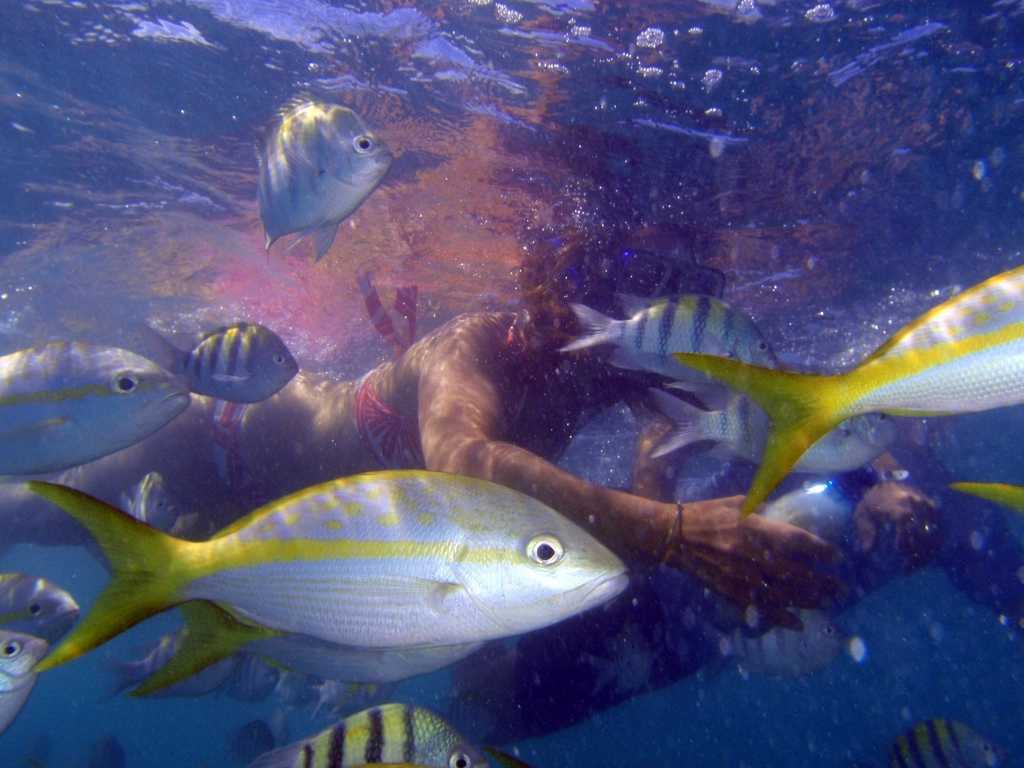
You do not need to dive. Much of the reef’s colour and life is in shallow water, and good snorkelling here is genuinely spectacular.
If you want to dive, most day boats offer an introductory dive with an instructor and no certification required. Certified divers will get more from a liveaboard or a smaller day operator.
Note the standard rule about flying after diving: leave a suitable interval, usually at least eighteen to twenty-four hours, before a flight. Check with your operator and plan your departure day accordingly.
Glass-bottom boats and semi-submersibles are available at the pontoons for anyone who would rather stay dry.
When to go
The dry season, roughly June to October, is the best window: less rain, better visibility, calmer seas and no stingers.
The wet season, roughly November to April, brings heat, humidity, cyclone risk and the presence of box jellyfish and Irukandji in coastal waters. Reef trips still run, and stinger suits are provided, but conditions are less reliable.
Coral spawning happens once a year after a full moon in late spring, and minke whales visit the northern reefs around June and July.
Visiting responsibly
- Never touch or stand on coral. It is a living animal and contact kills it.
- Use reef-safe sunscreen, or better, wear a rash vest and rely on fabric.
- Choose certified operators. Look for eco-certification and high-standard accreditation with the marine park authority.
- Keep your fins up and stay horizontal when snorkelling in shallow areas.
- Do not feed the fish, and take everything away with you.
- Pay the environmental management charge without grumbling; it funds the park.
Frequently asked questions
Is the reef still worth seeing?
Yes. It has suffered serious bleaching events and the damage is real, but large areas remain extraordinary, particularly the outer ribbon reefs and the southern sites. Choosing a good operator matters more than ever.
Can children snorkel?
Yes, with flotation vests, which operators provide. Pontoon-based trips suit families best because there is somewhere stable to rest.
Will I get seasick?
Possibly. The outer reef is a long, sometimes rough run. Take something before you board rather than once you feel unwell, and sit outside mid-ship.
How many days should I allow?
At least three in the region, so that a day of bad weather does not cost you the reef entirely.
What you will actually see
Expectations matter here, because the reef in a documentary and the reef on an average day are not the same thing.
On a good site you can expect hard corals in branching and plate forms, soft corals moving with the current, and clouds of small reef fish over the coral heads. Parrotfish, wrasse, damselfish, angelfish and giant clams are routine sightings.
Green sea turtles are common enough at many sites that most people see at least one. Reef sharks are frequently present and are not a concern. Rays, moray eels and the occasional large Maori wrasse round out the list.
What you will also see, in places, is bleached or dead coral. The reef has been through repeated heat events and the damage is not evenly distributed. Operators visiting outer sites and rotating between moorings generally show you healthier coral than the fixed inshore platforms.
What to bring on the boat
- A rash vest or long-sleeved swim top. Better than sunscreen for both your skin and the coral, and it doubles as stinger protection.
- Motion sickness tablets, taken before departure rather than after the first wave.
- A towel and a dry change of clothes. The wind on the return run is cold when you are wet.
- A waterproof camera or housing, if you want photographs; phones do not survive the day otherwise.
- Your own mask, if you have one that fits. Hire masks leak and a leaking mask ruins the experience.
- Cash or card for the environmental charge and for any optional dives booked on board.
Pingback: Best Time to Visit Queensland: A Month-by-Month Guide - Lisa World Travel