
Some links in this post are booking links. If you book through them we may earn a small commission at no extra cost to you. We only link to services we would use ourselves, and it never changes what we recommend.
Costa Rica packs an improbable amount into a small country: cloud forest, active volcanoes, two coastlines and more biodiversity per square kilometre than almost anywhere on earth. The mistake most first-timers make is trying to see all of it in ten days.
This itinerary deliberately picks three bases and stays put in each. Driving distances here are short on a map and long in practice, and every hour you spend on a mountain road is an hour you are not watching a sloth.
The route at a glance
- Days 1 to 3: La Fortuna and Arenal volcano
- Days 4 to 6: Monteverde cloud forest
- Days 7 to 10: Manuel Antonio and the Pacific coast
It is a loop that works from San José in either direction, and it gives you rainforest, cloud forest and coast without doubling back.
Days 1 to 3: La Fortuna and Arenal
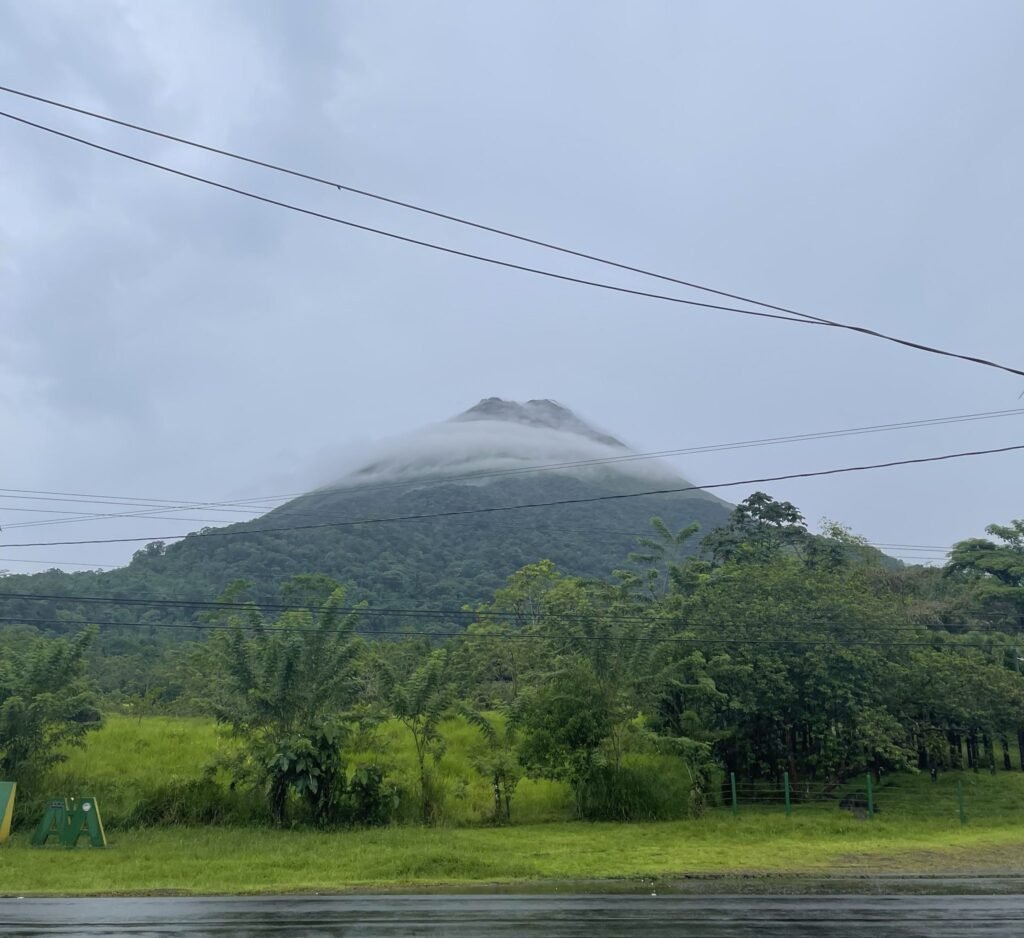
Roughly three hours from San José airport. Arenal is the near-perfect cone that appears on every Costa Rica poster, and it is worth knowing that it is no longer in an active eruptive phase, so you will not see lava. What you will see, cloud permitting, is one of the most striking volcano profiles anywhere.
Spend a day on the lava-field trails in the national park, which cross old flows with the volcano above you. Add the La Fortuna waterfall, reached by a long staircase down a gorge, with swimming at the bottom when conditions allow.
The hot springs are the other half of La Fortuna, ranging from elaborate resort complexes to free river spots where the water runs warm. A rainforest hanging-bridges walk, ideally guided, is the best wildlife option here.
Days 4 to 6: Monteverde
The journey from La Fortuna is the famous jeep-boat-jeep across Lake Arenal, which takes around three hours and is far more pleasant than the long road around. Book it through your accommodation.
Monteverde is cloud forest, which means cooler, wetter and often genuinely inside a cloud. Pack a fleece; people arrive in beachwear and regret it.
Do a guided early-morning walk in the Monteverde or Santa Elena reserve, because a guide with a scope will show you ten times what you would find alone. This is the best area in the country for a chance at a resplendent quetzal, particularly in nesting season. Add a night walk, which is when the forest is most active, and a zip line or hanging bridges for the canopy perspective.
Book your three bases
Lodges in Monteverde and Manuel Antonio are small and fill early in dry season. Compare options for each stop:
Days 7 to 10: Manuel Antonio
Down to the Pacific, around four hours from Monteverde. Manuel Antonio National Park is the smallest of Costa Rica’s major parks and the most reliable for wildlife: sloths, both howler and capuchin monkeys, and often squirrel monkeys, which are rarer elsewhere.
The park closes one day a week and limits daily visitor numbers, so buy tickets in advance online and go at opening. Hire a guide at the gate, or you will walk past most of what is there.
Keep the remaining days loose: the beaches inside the park are excellent, a mangrove boat tour is a completely different ecosystem, and a Savegre river trip or catamaran afternoon both work well. Do not feed the monkeys or leave bags unattended on the beach, for reasons that become obvious quickly.
Driving in Costa Rica
Hiring a car gives you real freedom, and shuttles are the alternative if you would rather not. If you do drive, budget roughly double the time any map suggests. Roads are winding, frequently single-lane through mountains, and rain changes everything.
A four-wheel drive is genuinely useful for Monteverde and unsealed access roads. Mandatory local liability insurance is charged on top of the headline hire rate, which is the single most common unpleasant surprise at the rental desk. Avoid driving at night, because unlit roads, pedestrians and potholes are a poor combination.
Seeing wildlife properly
The single best investment in Costa Rica is a guide. They carry a spotting scope, know where the sloth has been sitting for three days, and can hear a quetzal you would never notice. An unguided walk in the same forest will show you a fraction of it.
Dawn is when everything happens. Be at the reserve gate when it opens rather than mid-morning, and the difference is not subtle.
Frequently asked questions
Is ten days enough for Costa Rica?
Yes, for one coast and the central highlands at a sensible pace. Adding the Caribbean side or the Osa Peninsula needs fourteen days or a domestic flight.
When is the best time to go?
The dry season, roughly December to April, is the most reliable and the most expensive. The green season has afternoon rain, lower prices and lusher forest, and is a good trade for many trips.
Do I need vaccinations?
Check current advice with a travel clinic well before departure, as requirements depend on your route and where you have travelled previously. Mosquito precautions are sensible regardless.
Is Costa Rica expensive?
More than its neighbours, yes. Park fees, guides and imported goods add up. It is entirely possible to travel it cheaply by using local buses, sodas for meals and simple accommodation.
Pingback: Costa Rica on a Budget: What a Trip Really Costs - Lisa World Travel