
Some links in this post are booking links. If you book through them we may earn a small commission at no extra cost to you. We only link to services we would use ourselves, and it never changes what we recommend.
Marrakech is one of those cities that rearranges your expectations within an hour of arriving. The old walled medina is a maze of souks, workshops and hidden courtyards; step outside it and you are in Gueliz, a grid of cafes, galleries and wide boulevards that feels like a different country. Four days is the sweet spot: long enough to see the landmarks without rushing, and long enough to spend an afternoon doing very little, which is really what Marrakech is best at.
This itinerary assumes you are staying inside or near the medina, that you want a mix of sightseeing and downtime, and that you would rather eat well than tick off every monument. Distances are short, so you will walk more than you expect.
Day 1: The medina, slowly
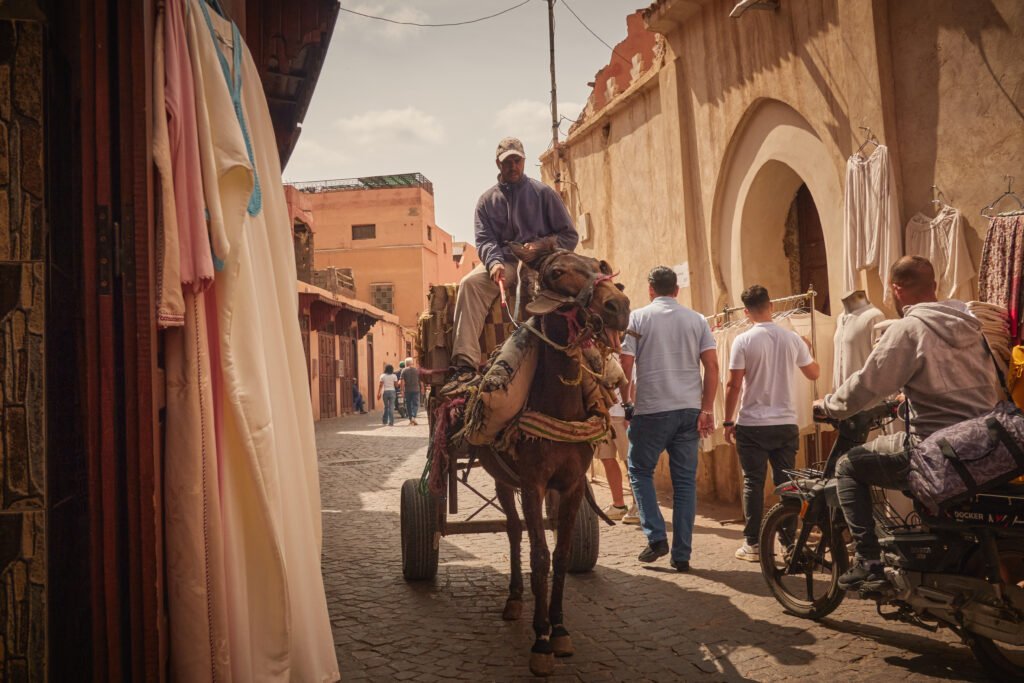
Resist the urge to plan your first morning tightly. Start at Jemaa el-Fnaa, the main square, early enough that the orange juice stalls are setting up and the crowds have not arrived. From there, walk north into the souks. There is no correct route. The lanes are organised loosely by trade, so you drift from leather to lanterns to spices without meaning to.
In the afternoon, visit the Ben Youssef Madrasa. It is a former Quranic school and the courtyard is the single most photographed space in the city for good reason: carved cedar, zellij tilework and stucco, all in one enclosed rectangle. Nearby, the Musee de Marrakech and the small Almoravid Koubba can be folded into the same walk.
Return to Jemaa el-Fnaa after dark. The square transforms: food stalls, musicians, storytellers. Eat at a stall if you are comfortable with it, or take a rooftop table on the perimeter and watch it from above.
A note on getting lost
You will get lost in the medina. Everyone does. Offline maps help but do not fully solve it, because many lanes are unnamed. The practical fix is to note a large landmark near your accommodation and ask for that rather than the street. Young men who offer to guide you will usually expect payment; agree that it is a paid service up front or politely decline and keep walking.
Day 2: Palaces, gardens and the new city
Begin at the Bahia Palace, a nineteenth-century complex built around a series of courtyards and painted ceilings. Go at opening time; it gets busy and the rooms are small. Afterwards, the Saadian Tombs are a short walk away and take under an hour.
In the afternoon, head out of the medina to Gueliz. The Jardin Majorelle, with its cobalt-blue buildings and bamboo, is the headline attraction, and the Yves Saint Laurent museum sits next door. Both are ticketed and both sell out at peak times, so book ahead where possible. If the queues put you off, the Le Jardin Secret inside the medina is quieter and, for some visitors, more atmospheric.
Gueliz is also where to eat if you want something other than tagine. The area has a strong cafe culture and a good number of modern Moroccan restaurants.
Day 3: A day trip, or a day off
Day three is your fork in the road. Two strong options:
- The Atlas Mountains. The Ourika Valley and Imlil are both within roughly ninety minutes of the city and give you cooler air, walking trails and Berber villages. A full day trip is the standard format and is easy to arrange.
- The Agafay Desert. Not the Sahara, despite the marketing, but a rocky desert far closer to the city. Popular for sunset dinners and camel or quad excursions. Good if you are short on time and want a desert evening without a long drive.
If you would rather stay in the city, this is the day to book a hammam. The traditional public hammams are inexpensive and communal; spa hammams attached to riads are gentler and more private. Either way, budget a couple of hours and do not plan much afterwards.
Day 4: Souks with intent, and a final rooftop
By day four you know the medina well enough to shop properly. Haggling is expected in the souks and is not adversarial; it is a conversation. Decide your ceiling before you start, stay friendly, and be willing to walk away. Fixed-price co-operatives exist if you would rather not negotiate at all.
Spend the last afternoon at the Koutoubia Mosque gardens, which are free and pleasant, then find a rooftop for sunset. The call to prayer across the city at dusk is the thing most people remember longest.
Where to stay in Marrakech
The core choice is riad versus hotel. A riad is a traditional house built around an internal courtyard, usually with only a handful of rooms, almost always inside the medina. They are atmospheric and personal, and staff will typically meet you at the nearest vehicle access point because taxis cannot reach the door. The trade-off is that rooms can be dark and you will walk to everything.
Hotels in Gueliz or the Hivernage district are easier for taxis, more likely to have a proper pool, and quieter at night. They are also further from the atmosphere you probably came for. For a first visit of four days, a medina riad is usually the better memory.
Book your Marrakech trip
Ready to turn this into a real trip? Compare riads, hotels and packages:
Practical notes
Cash still matters. Many riads, small restaurants and all souk stalls are cash only, and ATMs inside the medina can be unreliable. Carry small notes for taxis, which are metered in theory and negotiated in practice; agree the fare before you get in.
Dress is more relaxed than many first-time visitors expect, particularly in Gueliz, but covering shoulders and knees in the medina attracts less attention and is simply more comfortable in the sun. Friday is the traditional rest day and some businesses close or open late.
Check current entry and visa requirements with your own government’s travel advice before booking, as these change and are the one thing you cannot fix on arrival.
Frequently asked questions
Is four days enough for Marrakech?
Yes. Four days covers the medina, the main palaces and gardens, and leaves room for one day trip or a slow day. Two days feels rushed; a week is comfortable only if you are using the city as a base for the Atlas Mountains or the coast.
Is Marrakech safe for solo travellers?
Broadly yes, with normal city precautions. The most common complaints are persistent sales pressure and unofficial guides rather than anything more serious. Solo women often report more attention in the medina than in Gueliz. Walking confidently, declining firmly and avoiding empty lanes late at night covers most of it.
Do I need to speak French or Arabic?
No. Darija Arabic and French dominate, but English is widely spoken in tourism. A few words of French will smooth taxis and small shops considerably.
Should I visit the Sahara from Marrakech?
Only if you have the time. The Erg Chebbi dunes near Merzouga are roughly a nine to ten hour drive each way, so a genuine Sahara trip needs three days minimum. On a four-day city break, the Agafay Desert is the honest substitute.
What is the best month to go?
Spring and autumn. March to May and September to November give warm days without the summer heat, which regularly becomes uncomfortable for sightseeing in July and August.
Pingback: Zanzibar Itinerary: How to Spend 7 Days in Zanzibar - Lisa World Travel
Pingback: Cape Town Itinerary: How to Spend 5 Days in Cape Town - Lisa World Travel