
Some links in this post are booking links. If you book through them we may earn a small commission at no extra cost to you. We only link to services we would use ourselves, and it never changes what we recommend.
Melbourne does not have a harbour or an opera house. What it has is laneways, coffee, sport, street art and a restaurant scene that is arguably the best in the country.
Three days is enough to get it, provided you walk a lot and do not over-plan.
Day 1: the city centre and the laneways
Start at Federation Square and cross to the riverside, then head into the grid on foot.
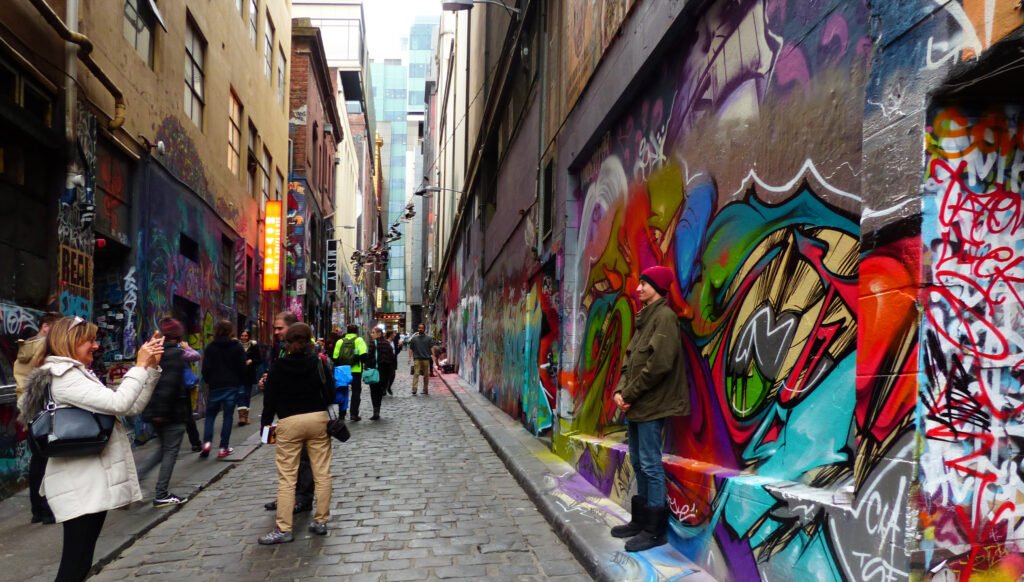
The laneways are the point: Hosier Lane and AC/DC Lane for street art, Degraves Street and Centre Place for coffee, Block Arcade and Royal Arcade for nineteenth-century shopping arcades that have survived intact.
Spend an hour in the State Library of Victoria for its domed reading room, and another in the NGV International on St Kilda Road.
Finish at Queen Victoria Market if the day suits, or in a rooftop bar above the grid as the light goes.
Where to base yourself
Stay inside the free tram zone or one tram stop from it and you will barely need transport:
Day 2: Fitzroy, Carlton and the parks
Take a tram north to Fitzroy. Brunswick Street and Gertrude Street are where Melbourne’s independent shops, record stores, bars and bookshops live. This is the best neighbourhood in the city for aimless wandering.
Carlton, next door, has Lygon Street’s Italian heritage, the Royal Exhibition Building and the Melbourne Museum.
In the afternoon, cross to the Royal Botanic Gardens and walk the Tan, or take the tram down to Albert Park.
Evening: dinner in Fitzroy or Collingwood, both of which are strong on small, chef-driven places that do not take themselves too seriously.
Day 3: beach, sport or a day trip
Three choices, depending on what you like.
Beach. Tram to St Kilda for the pier, the penguin colony on the breakwater at dusk, Acland Street cake shops and a long flat waterfront walk.
Sport. The Melbourne Cricket Ground is a genuine cathedral. Take the tour, or better, go to an Australian Rules match and watch the city lose its composure.
Day trip. The Great Ocean Road to the Twelve Apostles is the famous one, though it is a long day. The Yarra Valley wineries and the Dandenong Ranges are gentler alternatives, and Phillip Island has its own penguin parade.
Getting around
- Trams are the city’s circulatory system. Buy a myki card, touch on, and use them freely.
- The CBD free tram zone covers the central grid at no charge; you do not need to touch on inside it.
- The hook turn is a Melbourne driving quirk that catches everyone out. Avoid driving in the grid.
- Trains from Flinders Street and Southern Cross reach the suburbs and regional Victoria.
- The airport is connected by bus rather than rail; allow extra time in traffic.
Frequently asked questions
Melbourne or Sydney?
Sydney for the setting, Melbourne for the culture, food and street life. Most visitors with time do both; they are a short flight apart.
Is the weather really that changeable?
Yes. Four seasons in one day is the local cliché and it is accurate. Carry a layer and something waterproof whatever the forecast says.
When is the city busiest?
Around its major events: the tennis in January, the Grand Prix, and the spring racing carnival. Accommodation prices spike sharply during each.
Is three days enough?
For the city, yes. Add a fourth if you want the Great Ocean Road without rushing it.
Where to eat
Melbourne’s food is the reason many Australians visit, and it rewards wandering more than reservations.
Coffee is close to a civic religion. The small laneway cafés in the grid, and almost anywhere in Fitzroy, Collingwood or Carlton North, will serve you something better than most cities manage at any price.
Vietnamese food is exceptional in Richmond and Footscray, both a short train ride from the centre. Greek and Italian heritage runs deep, with Lygon Street the traditional home of the latter and Lonsdale Street of the former.
Chinatown on Little Bourke Street is one of the oldest continuous Chinese settlements in the western world, and it is still where the city eats late.
For a single food destination, the Queen Victoria Market deli hall on a weekday morning is hard to beat.
Melbourne with children
The city handles families well, and much of what works best is free or close to it.
- Melbourne Museum has a dedicated children’s gallery alongside the dinosaur and Indigenous cultures collections.
- Scienceworks in Spotswood is hands-on and includes a planetarium.
- The Royal Botanic Gardens have a children’s garden with water play and a maze.
- Riding the trams is an attraction in itself for younger children, and the free zone makes experimenting cheap.
- St Kilda combines a beach, a small amusement park and the penguin colony in one afternoon.
- Public pools across the inner suburbs are cheap, clean and where local families actually go in summer.
A rainy-day plan
Melbourne will rain on you at some point, probably without warning, and the city is unusually well equipped for it.
The NGV across its two sites can absorb most of a day. The State Library is free, warm and beautiful. ACMI at Federation Square covers film and video games and is more engaging than that description suggests.
The nineteenth-century arcades connect much of the central grid under cover, and the laneway cafés were built for exactly this weather.
Failing all that, ride a tram to the end of the line and back. It is a legitimate Melbourne activity and costs almost nothing.